

In early 2026, a century-old echo of American expansionism is reverberating in the Arctic. President Donald Trump—newly returned to the White House—has revived his controversial ambition to bring Greenland under U.S. control, openly declaring that the United States will act “whether they like it or not”[1]. He insists America “needs” the vast ice-clad island for national security, warning that if Washington doesn’t take Greenland, rival powers like Russia or China will[1]. This saber-rattling has provoked fierce backlash: Greenland’s elected leaders have emphatically rejected becoming “Americans,” Denmark has bristled at threats to its sovereignty, and U.S. allies in Europe warn that such aggression could shatter NATO[2][3]. The unfolding drama bears striking parallels to 1917, when the United States last acquired territory from Denmark – the purchase of the Danish West Indies (now the U.S. Virgin Islands). Yet it also starkly highlights how much the world has changed since that colonial-era transaction. Is Trump’s Greenland gambit a throwback to America’s old territorial ambitions, or something entirely new? This narrative dives into the latest developments of 2025–26, the global reactions, and the lessons (and limits) of the 1917 precedent in understanding this unprecedented situation.
Trump’s Renewed Push for Greenland (2025–2026)
Trump’s fixation with buying Greenland first made headlines in 2019 (when Denmark’s prime minister bluntly deemed the idea “absurd”). Dismissed then as a diplomatic misstep, the notion roared back to life after Trump’s 2024 election comeback. By late 2025, he began in earnest to translate this fantasy into policy. In December, Trump appointed Louisiana Governor Jeff Landry as a special envoy for Greenland – an unusual move that signaled Washington was treating the autonomous Danish territory as a target for incorporation[4][5]. “We need Greenland for national security, not for minerals,” Trump told reporters at Mar-a-Lago, directing Landry to “lead the charge” on making the Arctic island “a part of the US”[4][6].
The rhetoric only escalated with the new year. By January 2026, President Trump was openly discussing military options to acquire Greenland. “The president and his team are discussing a range of options... and of course, utilizing the U.S. military is always an option,” the White House confirmed in a statement[7][8]. In Trump’s view, U.S. ownership of Greenland had become a “national security priority” – essential to deter Russia and China in the Arctic[9]. American officials claimed the strategic island (with only ~57,000 people) was vulnerable to adversaries and rich in resources critical for high-tech and defense[10]. “You defend ownership. You don’t defend leases,” Trump argued, suggesting that America’s current military foothold on Greenland (such as the decades-old Thule/Pituffik air base) isn’t enough[11][12]. Only by possessing Greenland, he believes, can the U.S. guarantee that no foreign power ever uses the world’s largest island as a staging ground.
Trump’s own words have been extraordinary, even by the standards of hardball geopolitics. “We are going to do something on Greenland whether they like it or not,” he vowed, referring to the Greenlanders and Danes[1]. If Denmark refused to discuss a sale, Trump hinted the U.S. would take the “hard way” – a statement widely interpreted as a threat of forcible action[13]. In an interview with the New York Times, he bluntly explained his rationale: “ownership gives you things and elements that you can’t get from just signing a document.”[14] In other words, mere basing rights or treaties (the “easy way”) are, to Trump, insufficient substitutes for outright sovereignty. Behind closed doors, his administration has even floated unorthodox inducements: one plan under discussion involved offering lump-sum cash payments directly to Greenland’s 57,000 residents to persuade them to sever ties with Denmark and join America[15]. Such talk – effectively bribing a population to vote for U.S. annexation – underscores how far the White House seems willing to go.
Not everyone in Washington is on board. Trump’s own Republican aides have scrambled to downplay the specter of an armed invasion, emphasizing that the “goal is to buy the island… as opposed to using military force,” in the words of Secretary of State Marco Rubio[16][17]. And in a rare bipartisan rebuke, senior U.S. senators warned that America “must honor its treaty obligations and respect the sovereignty and territorial integrity of the Kingdom of Denmark” when Greenland and Denmark have made it clear [the island] is not for sale[18]. Still, Trump’s Greenland drive continues unabated – or as one White House official put it, “It’s not going away” during his term[19]. Emboldened by other foreign policy moves (such as a U.S. operation to capture Venezuela’s president, which Trump hailed as proof that American dominance in the hemisphere “will never be questioned again”[20]), the administration appears determined to redraw the map in the Arctic, international norms be damned.
“We Want to Be Greenlanders, Not Americans”: Local and Global Backlash
Trump’s renewed push has met immediate and adamant resistance from Greenlanders and Danes alike. The people whose future is at stake have not been shy about voicing their will. Greenland’s government and all major parties responded with a rare united front, condemning what they called “the U.S. contempt for our country”[21]. In a joint statement, leaders of Greenland’s five parties declared: “We do not want to be Americans, we do not want to be Danes – we want to be Greenlanders.”[21] The message was unmistakable: the island’s identity and sovereignty are not up for auction. Greenland’s Prime Minister, Múte Bourup Egede, stressed that only Greenland (in partnership with Copenhagen) will decide its future: “Greenland is for the Greenlandic people. We do not want to be Danish, we do not want to be American”[22]. That refrain – Greenland is not for sale – has echoed from Nuuk’s parliament to social media, a stark reminder that in the 21st century, the inhabitants of a territory expect a decisive say in their destiny.
A Danish flag flutters next to the Hans Egede statue in Nuuk, Greenland, ahead of a 2025 local election. Greenlanders’ push for greater self-rule – and eventual independence – has only grown stronger amid Trump’s attempts to claim the island[23][24].
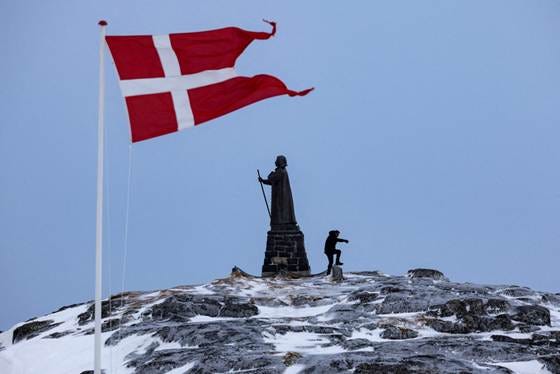
Greenland’s leaders have hastily convened emergency debates on how to respond to what they frankly term “threats to take control” of their land[25]. Ordinary Greenlanders, too, have made their stance clear: Polls and protests indicate broad support for independence from Denmark in the long run – but almost zero appetite to become part of the United States[26][27]. Even those Greenlanders who criticize Danish policies are recoiling at the notion of essentially trading one metropole for another. As one local lawmaker put it, Greenlanders seek more rights and even sovereign nationhood someday, “but don’t want to become part of the U.S.”[27]. The irony is not lost on anyone: Washington claims to champion Greenland’s freedom from foreign influence even as it pointedly ignores Greenlanders’ own wishes.
Denmark, which retains formal sovereignty over Greenland as an autonomous territory, has reacted with outrage – and anxiety. Danish officials have been walking a tightrope, balancing steadfast support for Greenland’s right to self-determination with diplomatic efforts to placate an important (and now adversarial) ally. Prime Minister Mette Frederiksen – the same leader who sparred with Trump in 2019 – has stated unambiguously that “Greenland belongs to the Greenlanders” and warned the U.S. to stop threatening Danish territory[28]. In a rare joint statement, Frederiksen and Greenland’s premier (then Jens-Frederik Nielsen) admonished, “You cannot annex another country… Not even with an argument about international security. Greenland is not a piece of property to be bought.”[28] Their message challenged the very premise of Trump’s proposal by invoking the post-World War II principle that sovereignty cannot simply be transferred over the heads of a population.
Across Europe and the international community, alarm bells are ringing. The notion of the U.S. coercively acquiring part of a fellow NATO member has been described as “historically unheard of”. Leaders from France, Germany, Britain, Canada, and others quickly voiced support for Denmark and Greenland, emphasizing that the island’s status can only be decided by its people and the Kingdom of Denmark[29][30]. “Borders must not be moved by force,” German Chancellor Olaf Scholz declared in early 2025, calling recent U.S. statements towards Greenland deeply unsettling[31]. French President Emmanuel Macron, during a visit to Greenland aimed at showing solidarity, insisted the territory “belongs to its people” with Denmark as its legitimate protector[32][33]. Even the European Union weighed in: EU officials reminded all parties that territorial integrity and sovereignty are fundamental principles of international law that cannot be bargained away[32].
Meanwhile, NATO – the military alliance that has bound North America and Europe together since 1949 – faces perhaps its gravest internal crisis. Danish Prime Minister Frederiksen bluntly warned that if the United States actually attempted to seize Greenland, it would mark “the end of NATO”[2]. The concept of one NATO founder using force against another cuts to the heart of the alliance’s collective defense ethos. “If the United States chooses to attack another NATO country… then everything stops,” Frederiksen said, underscoring that such a scenario would shatter the trust underpinning the alliance[3]. This is no idle talk: Article 5 of the NATO treaty commits members to defend any ally under attack – yet here Denmark would be the one under threat from its ally. Little wonder NATO’s Secretary-General (reportedly former Dutch PM Mark Rutte in this timeline) privately called the Greenland episode a nightmare scenario[34]. Even Russia – usually eager to capitalize on transatlantic rifts – has signaled opposition to any forcible change in Greenland’s status, with the Kremlin pointedly describing the Arctic as “a zone of [Russia’s] national interests” where the status quo must not be overturned lightly[35]. In effect, Trump’s gambit has managed a rare feat: uniting America’s friends and rivals in disapproval.
Strategic Stakes: Why Washington’s Eye Is on Greenland
Why is Greenland – an Arctic landmass of ice sheets and 56,000 hardy inhabitants – causing such heartburn in Washington? The answer lies in a confluence of geopolitical, economic, and military factors that have made the island an object of great-power competition in the 21st century. Geographically part of North America, Greenland sits at a strategic crossroads between the Atlantic and Arctic oceans. It is closer to New York than to Copenhagen, and its vast coastline forms part of the GIUK gap (Greenland-Iceland-UK) – a naval choke point long crucial for NATO defense. U.S. generals note that Greenland offers the shortest path for ballistic missiles between Europe and North America, making it ideal for early-warning radars and satellite surveillance systems[36][37]. Indeed, the U.S. Pituffik Space Base in northwest Greenland (formerly Thule Air Base) is a linchpin of America’s global missile warning network. Strategists argue that a “western-leaning Greenland” is vital to monitor Arctic sea lanes and any Russian submarines or Chinese vessels creeping near North American shores[36][37].
Economic interests also loom large. Greenland is often dubbed “resource-rich” – believed to harbor abundant rare earth minerals, critical for electronics and defense technologies, along with deposits of uranium, zinc, iron ore and potentially oil and gas[38]. As the Arctic ice recedes due to climate change, these resources are becoming more accessible, and new trans-Arctic shipping routes are opening. The U.S. (and China, and Russia) all covet secure access to the Arctic’s riches and emerging sea lanes[39][40]. American officials have explicitly highlighted Greenland’s untapped minerals as crucial for high-tech manufacturing and military supply chains – resources the West would rather not see fall under Chinese control[10]. (Beijing has shown interest in Greenland in the past, for example by courting mining projects and offering to finance airports, prompting Denmark and the U.S. to intervene and keep China at bay[41][42].) Trump’s national security advisor and allies have repeatedly argued that Denmark cannot fully develop or defend Greenland’s resources, and that U.S. stewardship (or ownership) would unlock the island’s economic potential for the benefit of the West[43][44].
Underlying all this is a resurgent great-power rivalry in the Arctic. Climate change is transforming the High North into a navigable, exploitable frontier. Russia has been beefing up its Arctic military capabilities – reopening bases, deploying radar and missile systems, and even staging joint exercises with China in Arctic waters[40][45]. China, for its part, declared itself a “near-Arctic state” and has sent research ships (often dual-purpose for surveillance) into Arctic seas, angling for a role in polar shipping and resource exploration[46][47]. The United States, some argue, was caught “flat-footed” in this Arctic competition for years[48]. Imran Bayoumi of the Atlantic Council notes that multiple U.S. administrations neglected Arctic strategy, and only recently has Washington awakened to the need for a bolder presence up north[48]. Trump’s almost obsessive focus on Greenland can be seen as an extreme reaction to this realization – a belief that securing the Arctic requires a dramatic, once-unthinkable move. As one State Department social media post put it, invoking a new “Trump Corollary” to the Monroe Doctrine: “This is OUR hemisphere.”[49] In Trump’s view, even Greenland – a self-governing territory of Denmark – falls within the U.S. sphere and must not slip into any rival’s orbit.
Critics, however, counter that Trump is offering a 19th-century solution to a 21st-century challenge. They point out that America already enjoys virtually all the military advantages it needs in Greenland under existing agreements. The 1951 U.S.-Denmark defense treaty gives American forces broad rights to operate bases on Greenland, and Denmark and Greenland have repeatedly said they welcome greater U.S. investment and troop presence – so long as it’s done in cooperation, not through coercion[50][51]. By mid-2025, Denmark even announced new investments to upgrade airports and radar infrastructure in Greenland (partly at U.S. urging) to improve the island’s defenses[52][53]. In short, if the United States wants more Arctic security, it could “simply ask” – and both Copenhagen and Nuuk would likely agree to deeper partnership[54][55]. Blowing up the NATO alliance and outraging Greenland’s populace in order to obtain what Washington already has access to has struck many analysts as counterproductive, even absurd. “It doesn’t make sense to blow up the NATO alliance for something [Greenland] that we already have,” remarked Ulrik Pram Gad, a Danish expert on Greenland, noting the U.S. can deploy troops there under current accords if needed[56][57]. Lin Mortensgaard of the Danish Institute for International Studies bluntly called Trump’s security justification “not true”: while Russian submarines patrol the Arctic, there is no invasion fleet lurking off Greenland’s shores, and Denmark’s cooperation with the U.S. in Arctic defense remains strong[58].
All of which raises the question: if the strategic and economic benefits of Greenland can be attained without owning it, why insist on ownership? Here we circle back to Trump’s worldview – one where deals are paramount and real estate logic applies even to geopolitics. Trump and some of his advisors seem drawn to the idea of a once-in-a-century territorial acquisition, a legacy “deal” to literally expand the United States. Reports have even surfaced of a cadre of American tech billionaires and venture capitalists – several of them major Trump donors – eyeing Greenland as a platform for futuristic projects (from mining to “free cities” with minimal regulation) that could profit immensely under a U.S. governance regime[44][59]. In that light, the Greenland gambit isn’t just about countering China or Russia; it’s about a Trumpian vision of American greatness that harks back to the era of manifest destiny, when buying or taking land was proof of national vigor. It is precisely this throwback mentality that unsettles so many in 2026. For better or worse, Trump’s Greenland adventure has forced the world to revisit the ethics of territorial expansion – a concept that largely fell out of favor after the dark mid-20th century chapters of annexation and colonial collapse.
1917 Flashback: How America Bought the Virgin Islands from Denmark
To understand the historical analogies (and limits) of the Greenland proposal, one must rewind to 1917, when the United States last acquired a substantial territory by purchase. The episode in question is the U.S. purchase of the Danish West Indies – a trio of Caribbean islands (St. Thomas, St. John, and St. Croix) that were Danish colonies from the 17th century until World War I. On March 31, 1917, those islands officially became the U.S. Virgin Islands after the United States paid Denmark $25 million in gold[60]. It was a culmination of half a century of on-and-off negotiations, driven largely by American strategic fears and Denmark’s waning imperial appetite[61][62].
The context then was in some ways similar to now: a great-power rivalry and a security chokepoint. In the 1910s, Germany was the rising threat on America’s horizon. U.S. leaders, including President Woodrow Wilson and Secretary of State Robert Lansing, worried that Germany might seize Denmark – and by extension, the Danish West Indies – to use as a naval base in the Western Hemisphere[63]. The Caribbean islands sit near the approach to the Panama Canal (which the U.S. was completing) and the sea lanes to the Gulf of Mexico. If a hostile European power controlled them, it could imperil both commerce and security. This echoed an even earlier concern: during the Civil War, the U.S. had first shown interest in buying the islands to preempt any European foothold near American shores[62]. By 1915, with World War I raging and German U-boats menacing Atlantic shipping (the sinking of the Lusitania sent shock waves), Washington’s determination grew. Wilson’s administration essentially delivered Copenhagen an ultimatum: sell us the islands, or risk having them taken. As one historian recounts, Lansing “insinuated that if Denmark didn’t sell…the U.S. just might go and seize them” to keep Germany out[64]. It was, in the words of that historian, a “bullying tactic, and it worked.”[64]
Denmark, a small neutral country at the time, reluctantly gave in under this pressure. A treaty was hastily negotiated in August 1916: the U.S. would pay $25 million in gold (a hefty sum then), and Denmark would cede the islands[60]. To legitimize the deal, Denmark held a referendum among Danish voters in late 1916 – a majority approved selling the colony[60]. Notably, the people actually living on St. Thomas, St. John, and St. Croix were not allowed to vote in that binding referendum[60]. (At the time, they were mostly Afro-Caribbean residents, many descended from enslaved laborers, with no political rights under Danish colonial rule.) However, a local civic leader, David Hamilton Jackson, organized an unofficial vote on St. Croix to gauge opinion. The result was stunning: 4,027 in favor of the U.S. transfer, only 7 against[60]. This lopsided result suggested that many islanders, frustrated by Danish neglect and hoping for better economic opportunities, welcomed becoming part of the United States. Indeed, Denmark’s initial hesitation to sell earlier in the 1900s had partly been over qualms of turning its mostly Black Caribbean subjects over to America’s racially segregated society[65]. But facing U.S. coercion and enticed by the gold payment, Denmark set those qualms aside. On Transfer Day – March 31, 1917 – the Danish flag came down in the islands and the Stars and Stripes rose.
From an American perspective, the 1917 Virgin Islands purchase was a strategic masterstroke. It eliminated a potential German beachhead near Panama and extended U.S. control over a key stretch of the Caribbean. It was also one of the last major acts of the American age of expansion: coming on the heels of the 1898 Spanish–American War, which had given the U.S. Puerto Rico, Guam, and the Philippines, the purchase underscored that the U.S. now considered itself the dominant power in the Caribbean (per the Monroe Doctrine). As one historian put it, Denmark’s imperial decline met America’s imperial rise, resulting in a transfer of ownership[61].
Crucially, however, the people of the Virgin Islands had little say in their fate beyond that unofficial vote. They effectively went from being subjects of the Danish Crown to subjects of the United States – without consultation in the treaty’s terms. The treaty itself referred to the cession of the islands “together with the inhabitants thereof” to U.S. sovereignty[66]. And while the transfer occurred peacefully, the aftermath was murky for island residents. Initially, the U.S. did not grant U.S. citizenship to Virgin Islanders. They were defined in 1920 as having “American nationality” but not full citizenship rights[67]. It was only in 1932 – 15 years later – that Congress granted citizenship to people of the U.S. Virgin Islands[67]. Even then, as a colonial territory (and later an unincorporated U.S. territory), they did not get to vote for U.S. president and had no voting representation in Congress – a disenfranchisement that persists to this day (like residents of Puerto Rico and other territories)[68]. Local self-government also came gradually; U.S. Navy officers governed the islands for some years, and Virgin Islanders only won the right to elect their own governor in 1970[68]. In short, the 1917 purchase, while bloodless, was a classic example of a great power swapping colonies and only later grappling with what political rights the annexed population should have.
Parallels and Contrasts: American Ambitions Then and Now
Trump’s pursuit of Greenland in 2025–26 invites comparison with 1917’s Virgin Islands deal – and the juxtaposition is illuminating. On the surface, there are clear parallels between the two episodes:
Strategic Urgency: Both cases were driven by U.S. fears of rival powers establishing a foothold in a strategic territory. In 1917, it was Germany in the Caribbean; in 2026, it’s Russia or China in the Arctic. In each instance, American leaders argued that acquiring the territory was essential to preempt an adversary’s move[63][1]. As Trump insists today, “if we don’t do it, [Russia or China] will”[69], echoing the Monroe Doctrine logic that also underpinned the Caribbean purchase[70][65].
Pressure on Denmark: In both episodes, the U.S. pressured Denmark to give up control of a Danish territory. It’s a historical irony that Denmark – a small nation with far-flung colonies – has twice found itself in Washington’s crosshairs. In 1917, Wilson’s administration privately threatened Denmark with possible military action if it refused to sell the Virgin Islands[64]. In 2025, Trump has publicly mused about forcible action (“the hard way”) and even hinted at using the U.S. military against Greenland/Denmark[13][7]. The rhetoric differs in tone (quiet diplomacy then, Twitter and press conferences now), but the dynamic of a great power strong-arming a smaller ally over territory is a common thread.
Willingness to Pay – and Profit Motives: America was ready to write a hefty check in 1917 – $25 million (over $500 million in today’s dollars) – to consummate the Caribbean deal[60]. Trump likewise has floated the idea of literally purchasing Greenland outright from Denmark (or even paying Greenlanders directly)[71][15]. In fact, discussions in Washington have revolved around what a fair price might be for Greenland’s 2.1 million square kilometers of land and ice. Some U.S. lawmakers have cynically quipped “if the price is right” perhaps buying Greenland is reasonable[72][73]. This hearkens back to earlier U.S. land deals like the Louisiana Purchase (1803) and Alaska Purchase (1867) – and indeed, senators in 2025 explicitly invoked those precedents, suggesting another big purchase “would be a reasonable conversation”[73]. The underlying mindset is similar: in America’s expansionist past, territory was something that could be bought, and doing so was often celebrated as statesmanship. Trump clearly sees himself as a dealmaker in that tradition. Moreover, in both 1917 and 2026, there are economic interests salivating at the prospects – whether it was the plantations and harbors of St. Croix back then, or Greenland’s rare earth mines and potential oil today.
Despite these echoes, the differences between 1917 and 2026 are just as stark:
Colonial Era vs. Modern Self-Determination: The most important contrast is the status of the local population’s rights. In 1917, the idea that the inhabitants of a colony should consent to a transfer was a relatively novel, weak notion. (Denmark’s failure to secure local consent in an earlier attempted sale in 1902 helped scuttle that deal in the Danish parliament[74], but by 1917 Denmark proceeded anyway, with only perfunctory nods to local opinion.) The people of the Danish West Indies were not consulted in any binding way; their fate was decided above their heads by colonial powers[60]. In 2026, by contrast, Greenland’s people have an internationally recognized right to decide their own future. Greenland is not a colony in the classic sense but an autonomous territory with self-rule, its own parliament, and a 2009 Danish law that explicitly grants Greenlanders the option to declare independence via referendum whenever they choose[24]. International law today strongly emphasizes self-determination – a principle born after World War II and the end of imperial colonies. This means any attempt to transfer or change Greenland’s status without the Greenlandic people’s consent flies in the face of contemporary norms. It is precisely why Greenland’s leaders and European allies keep repeating that only Greenland (and Denmark, as the kingdom’s other party) can make decisions about its sovereignty[75][32]. The world of 1917 had no United Nations, no decolonization movement, and no norm against buying territories; the world of 2026 does, and Greenland’s case tests those norms in real time. What might have been acceptable or at least commonplace a century ago is now widely viewed as anachronistic or illegal. As one Danish commentator observed, Trump’s proposition is “flagrant disrespect of international law” in a way that simply wouldn’t have registered in 1917[76].
Global Reaction and Alliances: In 1917, the transfer of the Virgin Islands was met with little international fanfare or protest. The U.S. and Denmark were sovereign states making a deal; other powers largely shrugged (indeed, Britain and France had both contemplated buying the islands themselves earlier, so the concept wasn’t shocking)[77][78]. By contrast, Trump’s Greenland gambit has triggered global condemnation and could rupture the Western alliance. The United States and Denmark are close NATO allies in 2026 – the idea of the U.S. even considering military action against Danish/Greenlandic territory is nearly unthinkable (calling it NATO’s potential “darkest hour” is no exaggeration[79][80]). In 1917 there was no NATO, and power politics were more raw; great powers routinely carved up smaller nations’ lands (often as spoils of war or through treaties) without declaring war on each other. Today, NATO’s foundation and the UN Charter explicitly forbid acquiring territory by force[80]. Thus, the diplomatic fallout in 2025–26 – European Union statements, NATO crisis meetings, public fury – has no parallel in 1917. We are witnessing an attempt at territorial acquisition in an era that thought such maneuvers relegated to history. The result is diplomatic shockwaves far beyond the immediate players, something that wouldn’t have occurred in the more permissive imperial context of 1917.
Treatment of the Territory After Acquisition: Another telling difference is how the transition and governance might play out. In 1917, when the U.S. took over the Virgin Islands, it essentially ran them as a dependency with minimal local input for decades[67][68]. There was no immediate incorporation as a state or equal footing in the union; inhabitants lived under U.S. naval administration initially, then as an unincorporated territory – a subordinate status that persists. If, improbably, Greenland were to come under U.S. control, what would its status be? Trump has at times mused that Greenlanders would “love to become” Americans – even suggesting they might eventually become a U.S. state[81][82]. But skeptics note that the U.S. has never admitted a non-contiguous territory as a state (Alaska and Hawaii were incorporated territories for decades before statehood, and had primarily U.S. settler populations by then). More likely, Greenland would be kept in a territorial status for a long time. Would Greenlanders automatically get full U.S. citizenship and rights? The historical track record (from Puerto Rico to Guam to the Virgin Islands) shows that territorial residents often lack voting rights and equitable benefits. Greenlanders are acutely aware of this – as Danish citizens, they currently enjoy generous social welfare and universal healthcare from Denmark. Many have noted they could lose those benefits if subject to U.S. systems, without necessarily gaining an equal voice in Washington. Even a pro-Trump Danish politician, Morten Messerschmidt, argued that Greenlanders would prefer Denmark’s social safety net to American arrangements, quipping that “Greenland will never gain independence [via the U.S. route]… Greenlanders know where they have it best”[83][84]. In short, the people of Greenland have far more leverage and information about their fate than the Virgin Islanders did in 1917, and they are using it to avoid what they suspect would be a raw deal. The century-old pattern of big powers trading territories like poker chips cannot repeat easily when the “chips” can speak, vote, Tweet, and appeal to international law.
Intent vs. Execution: Finally, there’s a difference in how far the U.S. is really willing to go. In 1917, the U.S. threat was veiled but credible, and ultimately a deal was amicably struck. In 2026, despite Trump’s bluster, there remain serious doubts that the U.S. would actually defy global opinion and invade or forcibly annex Greenland. High-ranking American military and political figures (even those close to Trump) have expressed deep misgivings. They know such an action could destroy alliances and isolate the U.S. on the world stage[85][86]. One Danish scholar wryly noted that, on a personal level, if Trump ever ordered an attack on Greenland, it would torpedo any hopes he has of a Nobel Peace Prize for other endeavors[87][88] – a goal he has reportedly cherished. More practically, cooler heads in Washington and even within Trump’s party are likely to “pull the handbrake on such an unreasonable idea” as invading a peaceful territory[89][90]. In 1917, military force was a straightforward extension of policy if needed (the U.S. was on the verge of entering WWI and had no qualms using might). In 2026, the U.S. contemplating an unprovoked assault on an ally would be anathema to many in the Pentagon and Congress. Thus, Trump’s Greenland gambit may remain, in the end, more of a provocative negotiating ploy or political theater than a literal repeat of 1917. The very fact that it has progressed this far, however, speaks volumes about changing global power dynamics – and perhaps about Trump’s singular approach to foreign policy.
A New Era of Territorial Ambitions, or an Anachronism?
The saga of Trump’s interest in Greenland has opened up a Pandora’s box of questions that many believed long settled. It forces us to ask: Are we witnessing a genuine revival of old-style great-power land grabs, or is this a quixotic one-off driven by an individual’s unconventional vision? In some respects, Trump’s Greenland obsession does feel like a historical throwback – a U.S. president treating territory as a commodity, floating purchase prices, and brushing aside local wishes in favor of grand strategy. Not since the age of William Seward (who bought Alaska in 1867) or Woodrow Wilson (who oversaw the Virgin Islands deal in 1917) have we seen such overt territorial ambition from the White House. It’s telling that observers keep reaching a century into the past for analogies – it underscores how out of step this is with recent U.S. foreign policy. For the last many decades, American influence expanded through alliances, economic power, and sometimes military interventions – but not by adding land to the map. The post-1945 international order frowned on annexations (the few attempts, like Russia’s seizure of Crimea in 2014, have been widely condemned). In launching a bid for Greenland, Trump has arguably resurrected a taboo. As Greenland’s foreign minister remarked, this episode has forced both Greenland and Denmark to “reevaluate each other” and their place in the world[91][92]. It has even prompted Denmark’s Intelligence Service to do the unthinkable – label the United States as a potential challenge to Danish security, right alongside Russia and China[76].
And yet, for all the talk of imperial echoes, many analysts believe this saga is more of an aberration than a harbinger. Trump’s personal style – blending zero-sum transactionalism with a flair for the dramatic – is a significant factor. The Greenland idea might emanate less from a calculated return to colonial-era policy and more from Trump’s unique mindset as a real estate developer-president (who famously joked in 2019 about building golf resorts on a “purchased” Greenland). Future U.S. leaders, Democrat or Republican, may not share this inclination. Indeed, the bipartisan pushback Trump has received domestically suggests that institutionally, the U.S. is not eager to reopen the age of territorial expansion[18]. In the long run, America’s interests in the Arctic can be pursued through cooperation and influence – as was largely the approach even during the Cold War – rather than through owning foreign land. In fact, the turmoil unleashed by Trump’s gambit may serve as a cautionary tale, reaffirming that 21st-century power is usually better exercised through partnerships than possession of territory.
For Greenland, the Trump era pressures have been a double-edged sword. On one hand, they have caused anxiety and a feeling of being a pawn in a superpower game. On the other, they have drawn global attention to Greenland’s aspirations and concerns. Greenlandic representatives have seized the moment to broadcast their desire for eventual full independence and to attract investment on their own terms, not as a token in someone else’s empire[93][94]. As one Greenlandic cabinet minister noted, Trump’s interest has inadvertently increased the island’s “value” in the eyes of the world and “freaked out Denmark” enough to perhaps negotiate more earnestly on future arrangements[93][95]. In that sense, the crisis has empowered Greenland’s quest to step out of the shadow of both Denmark and the U.S. and define its destiny as neither a Danish colony nor an American outpost, but a sovereign Arctic nation in its own right (when and if its people decide so).
In 1917, a territorial purchase could be seen as win-win: Denmark shed a costly colony and got cash, the U.S. gained strategic islands, and the local populace, while voiceless, hoped for a better life under a new flag. In 2026, the calculus is far murkier. Denmark has no desire to sell, seeing Greenland as an equal part of its kingdom. The Greenlandic people have spoken loudly that they cannot be bought. The United States, for all its power, is constrained by alliances and principles it helped establish. Any attempt to unilaterally grab Greenland “the hard way” would isolate Washington and undermine its moral authority – a price far higher than $25 million in gold.
As this extraordinary chapter continues to unfold, one thing is clear: the age of territorial deals is not completely dead, but its ghost appears in discordant ways, provoking more ire than enthusiasm. History may not repeat, but it rhymes – and the rhyme we hear in Trump’s Greenland gambit carries both the familiar drumbeats of great-power strategy and the jarring dissonance of a world that thought land auctions belonged to the past. Whether this episode ends in confrontation, capitulation, or simply fizzles out, it has already forced a reckoning with America’s identity: Are we a nation content to lead through influence and example, or do we still hunger for the old mapmaking authority of an empire? The answer, it seems, will be written in the icy fjords of Greenland – watched closely by the 57,000 Greenlanders whose future hangs in the balance, and by the rest of a world re-learning the value of sovereignty in the face of revived ambitions.
Sources:
· Reuters – “Trump says US needs to own Greenland to deter Russia, China” (Jan. 10, 2026)[1][12]
· Reuters – “Trump discussing how to acquire Greenland, US military always an option, White House says” (Jan. 7, 2026)[7][18]
· Reuters – “Greenland’s parliament to discuss US threats… ‘We want to be Greenlanders’” (Jan. 10, 2026)[21][24]
· Al Jazeera – “Trump says Greenland ‘essential’ for security: Could he take it by force?” (Dec. 23, 2025)[28][32]
· Associated Press – “How the US could take over Greenland and the potential challenges” (Jan. 10, 2026)[2][3]
· History.com – “The U.S. Bought 3 Virgin Islands from Denmark. The Deal Took 50 Years.”[96][67]
· Wikipedia – “1916 Danish West Indian Islands sale referendum”[60] (details on the 1917 Virgin Islands transfer)
· Atlantic Council – “Trump’s quest for Greenland could be NATO’s darkest hour” (Jan. 7, 2026)[97][76]
[1] [11] [12] [15] [69] [75] Trump says US needs to own Greenland to deter Russia, China | Reuters
https://www.reuters.com/world/china/trump-says-us-needs-own-greenland-deter-russia-china-2026-01-09/
[2] [3] [13] [14] [27] [48] [54] [55] [56] [57] [58] [85] [86] How the US could take over Greenland and the potential challenges - ABC News
https://abcnews.go.com/US/wireStory/us-greenland-potential-challenges-129078605
[4] [5] [6] [26] [28] [32] [33] [36] [37] [38] [39] [40] [45] [46] [47] [87] [88] [89] [90] Trump says Greenland ‘essential’ for security: Could he take it by force? | Military News | Al Jazeera
[7] [8] [9] [10] [16] [17] [18] [19] [20] [29] [30] [71] Trump discussing how to acquire Greenland, US military always an option, White House says | Reuters
[21] [24] [25] Greenland’s parliament will bring forward meeting to discuss US threats, party leaders say | Reuters
[22] [31] [35] [41] [42] [52] [53] [72] [73] [81] [82] [83] [84] [91] [92] [93] [94] [95] Proposed United States acquisition of Greenland - Wikipedia
https://en.wikipedia.org/wiki/Proposed_United_States_acquisition_of_Greenland
[23] [34] [43] [44] [49] [50] [51] [59] [76] [79] [80] [97] Trump’s quest for Greenland could be NATO’s darkest hour - Atlantic Council
https://www.atlanticcouncil.org/dispatches/trumps-quest-for-greenland-could-be-natos-darkest-hour/
[60] [74] 1916 Danish West Indian Islands sale referendum - Wikipedia
https://en.wikipedia.org/wiki/1916_Danish_West_Indian_Islands_sale_referendum
[61] [62] [63] [64] [65] [66] [67] [68] [70] [77] [78] [96] The U.S. Bought 3 Virgin Islands from Denmark. The Deal Took 50 Years | HISTORY
https://www.history.com/articles/us-virgin-islands-denmark-purchase